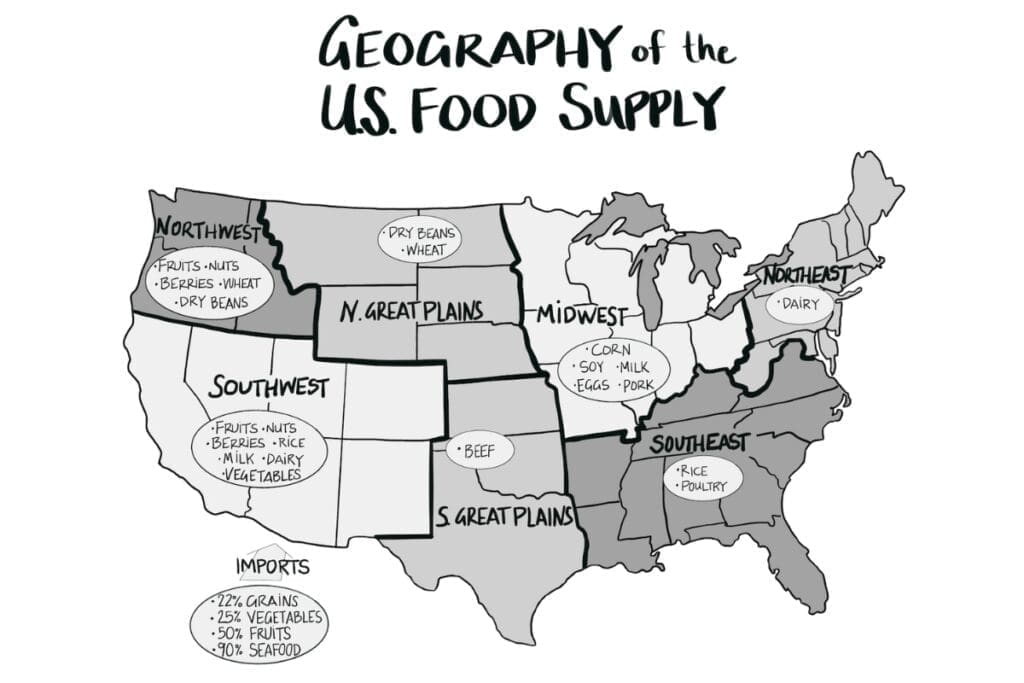
Congress created a useful legal definition of sustainable agriculture in the Food, Agriculture, Conservation and Trade Act of 1990. This definition explicitly acknowledges the multiple dimensions of sustainability—ecological, social and economic— and provides a general description of the purpose of sustainable agriculture and some desirable qualities and behaviors:
The term sustainable agriculture means an integrated system of plant and animal production practices having a site-specific application that will, over the long term:
- satisfy human food and fiber needs
- enhance the environmental quality and the natural resource base upon which the agricultural economy depends
- make the most efficient use of nonrenewable resources and on-farm resources and integrate, where appropriate, natural biological cycles and controls
- sustain the economic viability of farm operations
- enhance the quality of life for farmers and society as a whole
This definition of sustainable agriculture became my touchstone as I worked to understand resilience and apply it to the question of climate change adaptation in food and farming systems. While it seems pretty simple at first glance, this definition highlights some important distinctions between industrial and sustainable agriculture.
The focus on ecological health and community well-being as the basis of agricultural productivity clarifies a fundamental difference between sustainable and industrial agriculture. The industrial philosophy of agriculture views the production of agricultural products as no different from the industrial production of other goods. The farm is a factory, the plants and animals are workers on an assembly line. The farmer is the factory manager, tasked with managing purchased energy and materials to produce high volumes of uniform products as quickly as possible, at the lowest cost possible and with as little labor and land as possible.
The resilience of the U.S. industrial food system is achieved through continuous financial subsidy in the form of publicly-funded research and development, direct payments, cost-share programs and subsidized crop insurance and disaster payments, along with additional resource subsidies acquired through the exploitation of fossil fuels and the degradation of soil, water, air quality, biodiversity and community health and well-being. Paradoxically, public support for industrial food has at the same time eroded its resilience, because this support shelters the system from social and environmental disturbances.
We know that food systems are more vulnerable to global disturbances and shocks when they have the following characteristics: a heavy reliance on external or distant resources; low diversity; inequitable access to resources; inflexible governance; highly specialized production, supply and marketing chains; and subsidies (both financial and technological) which mask environmental degradation. These characteristics, widely recognized as the root cause of the environmental, social and economic harms of the U.S. industrial food system, take on new importance as we consider how to best sustain American agriculture in a changing climate.
The sustainable philosophy of agriculture takes a broader view of the potential contributions of agriculture to society. This view recognizes that agriculture has the capacity to produce many ecological and social goods in addition to supplying sufficient food and fiber. As the definition declares, agricultural operations have the potential to enhance (improve and sustain) natural resources, farm profitability and quality of life both on and off the farm. Agricultural operations that are most likely to realize this potential will do so through specific behaviors, for example, the use of practices that:
- manage for broad resource efficiency (not just land and labor)
- integrate crops and livestock (rather than separate them)
- cultivate ecosystem services (rather than exploit and degrade them)
- tailor practices to local social-ecological conditions (rather than overcome them)
Perhaps you are beginning to see why I started to wonder about the resilience of sustainable agriculture. It seemed to me that the desirable outcomes included in the legal definition of sustainable agriculture made a pretty good start at following the three rules of resilience:
- Diverse networks of equitable relationship are cultivated by the requirements that agricultural operations use practices with site- specific application (i.e., be place based), integrate plants and animals, make use of natural biological cycles and controls, and enhance environmental quality, natural resources, the financial viability of farms and the quality of life for farmers and society as a whole.
- Regional self-reliance is cultivated by the requirement that agricultural operations use site-specific practices that enhance natural resources, make efficient use of nonrenewable resources and on-farm resources in order to satisfy human food and fiber needs, sustain farm viability and enhance the quality of life for farmers and society as a whole.
- Community-based wealth is cultivated by the requirements that agricultural operations satisfy human needs, enhance natural resources, sustain farm profitability and enhance the quality of life for farmers and society as a whole.
Although it seemed like a pretty good start, I still had a lot of questions. Have experienced sustainable producers noticed changes in weather patterns? Have they made any changes to their operations because of changing weather patterns? Do sustainable farming practices like crop diversity and the integration of crops and livestock increase or decrease vulnerability? How does the substitution of on-farm resources for purchased inputs change farm sensitivity to variable weather and extremes? Can diversified, place-based practices sustain the economic viability of farms despite being ineligible for the public subsidies provided to industrial farms? Do sustainable producers have access to the knowledge and tools they need to manage climate risk? How do sustainable producers think about the resilience of their operation? What are the barriers to and opportunities for the development of a sustainable U.S. agriculture capable of sustaining community well-being as the pace and intensity of climate change increase in the coming years?
Will Harris has made the shift from industrial to sustainable to resilience thinking over the 50 years that he has owned and operated White Oak Pastures, a regenerative, multi-species livestock operation in southwest Georgia near Bluffton. Will continued the industrial practices he inherited from his father when he took over the farm in the 1970s, but transitioned to organic pasture-based production in 2000, and then to regenerative agriculture in 2015. Will shares these thoughts about the differences between industrial and regenerative agriculture:
You know, most of the people that operate in this high animal welfare/high environmental sustainability farming model are younger people who came to it from somewhere else. Not many of them are like me, or only a small percentage— former monocultural, commoditized, centralized, industrialized farmers— but I’m one of them. And I’m like a reformed prostitute, you know, I’ve got the zeal of the convert.
I love the debate that I get into occasionally, probably a little bit more than most, because I am one of the good old boys. They say, ‘You know, the way you farm won’t feed the world versus the way we farm. We’re feeding the world,’ and I love it when they say that, because they say, ‘You just can’t produce enough.’
When they say that, I try not to smile, and I say, ‘Okay, let’s have that debate, but before we have that debate, I want us both to stipulate that neither farming system will feed an endlessly increasing population.’ The Earth has got a carrying capacity, and once you get beyond that carrying capacity, neither one of them is going to feed the world.
And most of them will stipulate that. They don’t want to, but they eventually will. And I say, ‘Okay, well, I’ll go ahead then and capitulate right up front that if we’re going to run out of acres first, you win. You can feed way more people than I can if acres are the only limiting factor. If we’ve got unlimited water, unlimited petrol fuel, unlimited antibiotics that don’t create pathogen-resistance, unlimited fertilizer resources… you win.
But now if the limiting factor becomes water, I’m probably going to win, because I don’t use as much water as you do. If the limiting factor becomes petro fuel, I win, because I don’t use as much of it as you do. And if the limiting factors become phosphates and potash and these other depleting resources, I win, because I don’t use as much as you.’ And antibiotics, and pesticides, and so on…I win just about any way we do it other than acreage.