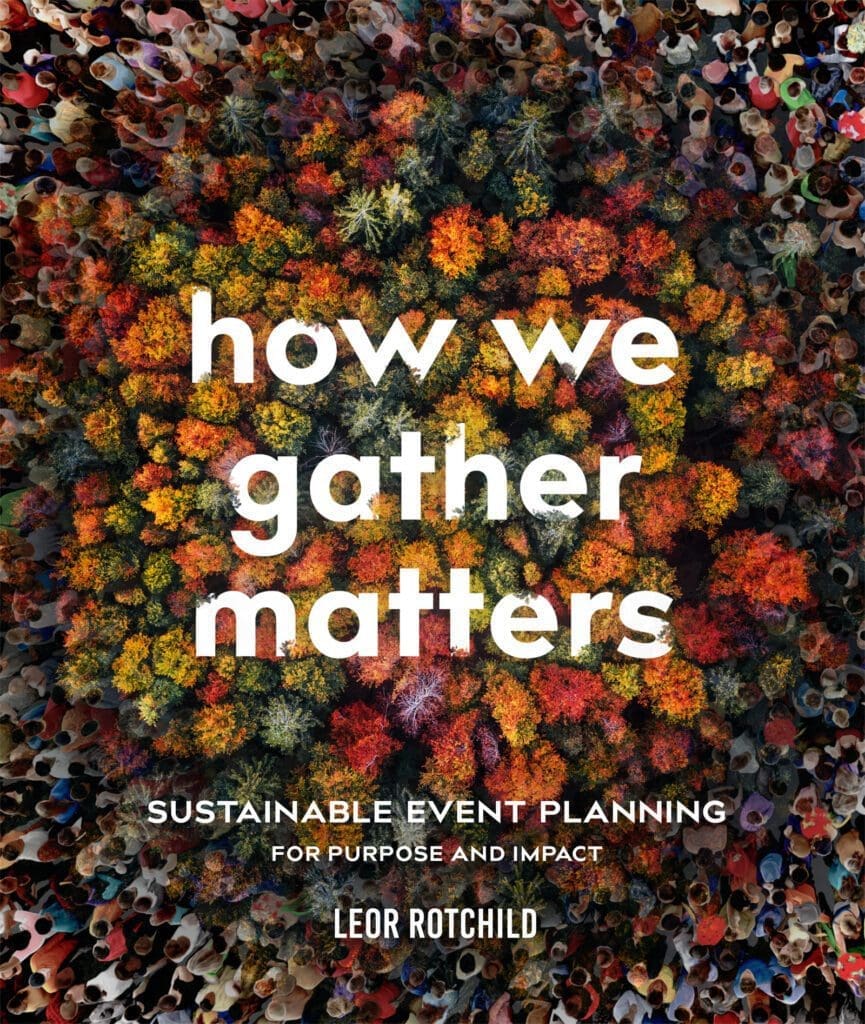
Events can educate, inspire, and connect, but all too often they escalate into resource-intensive glorifications of excess and exclusivity. How We Gather Matters provides insight and practical tools to unleash the potential of gatherings to help create a more purposeful, inclusive, waste- and emissions-free society.
Grow your audience, shrink your footprint, change the world
Events can help educate, inspire, and connect us to our community, but all too often they escalate into resource-intensive glorifications of excess and exclusivity. How We Gather Matters is an invitation to reimagine the modern events industry as a powerful vehicle for change.
This practical guide will enable and inspire festival, conference, trade show, wedding, concert, and sporting event planners to:
- Develop the financial and human resources required to implement green, sustainable gatherings
- Collaborate effectively with diverse teams and stakeholders
- Design events with impact and purpose, while supporting marketing and strategic goals
- Engage participants authentically while aligning with positive and progressive values
- Lead the shift towards net-zero emissions and zero waste by leveraging best practices and accepted international standards.
Packed with personal insights, behind-the-scenes stories, and case studies, How We Gather Matters is required reading for event professionals who want to decrease risk, increase profitability, and meaningfully contribute to a more just, inclusive, and sustainable society.








Theresa O’Connell –
I received this as an ARC. Thank you New Society Publishers.
This book is about how as a society, we can make big events such as festivals, fairs, and concerts sustainable with less or no waste events.
While I was reading the book, many of the ways mentioned, such as reusable plates, drink ware and flat ware, reminded me of monthly potlucks or pitch-ins that we have at places of worship or community meals.
One of the main areas that sparked my interest was, how to travel to events in a much greener way. I liked the idea of public transit teaming up with event venue to get people where they needed to be without having to rely on cars. Thus making the events easier to breathe at and more enjoyable for everyone.
So next time you are planning a big event that is earth friendly, this book can be used as a guide.
Annette Flinterman –
The aim of events is to connect people, connect a community and the author gives clear ideas, steps and examples to engage everyone involved for more sustainable events, avoiding green washing (clarified using the 6-headed hydra of greenwashing). Events are more memorable, enjoyable, and ultimately more profitable when they serve a deeper purpose and catalyse for collective action. This book gives ideas of questions to ask and principles and values one can use to set clear goals, produce zero waste and it takes to move away from plastic water bottles. How important deep listening is, to really engage with people (own team, vendors, audience…) and understand where they are coming from and what they need to move forward and make responsible changes. This is often overlooked, but finding a connection and common goal is most important to get further. Something I also encounter in discussions about climate actions.
Another aspect highlighted is the use of inclusion, creating a safe space for everyone who wants to attend. Very interesting was the table with reasons why women are often left behind as well as all the examples clarifying what diversity really means. Great is also the list of questions, to find the right venue.
As mobility generally is the strongest Carbon-producer of an event, much attention is given how to reduce this, make it greener and how to promote that. Shocking was to read about the “Elephant in the room” – how the aviation industry is trying to offset their carbon imprint by for example using SAF – Sustainable Aviation Fuels, which actually take away agricultural land for food production.
Loads of ideas and tips to get started!
Rachel –
First, this book isn’t just for event planners; it’s for anyone who wants to be in a better position to evaluate if an event is sustainable and ethical, even if they’re just an attendee. “How We Gather Matters” has so much information for anybody who participates in any capacity—as an organizer, attendee, vendor, venue operator, local government partner, etc. Much of the information can also be scaled down and applied to smaller gatherings, like weddings, church functions, and graduation parties. I particularly enjoyed the chapters on aiming for zero waste, eliminating bottled water, and planning for net zero emissions, and appreciated that there was a separate chapter on the impact of travel to/from the event, since that’s something organizers (and attendees) often don’t consider or attempt to mitigate. The author provides fairly detailed examples of large events, and their successes, as well as honest assessments of areas where the outcome wasn’t quite what was hoped for, or where there is still work to be done. Overall, this book is thought-provoking and comprehensive, without being overwhelming, and the many descriptive examples of events make it an enjoyable read.
Daria Rakowski –
This book is a good resource for large scale event planning (think corporate level sponsorship scale events). It’s not necessarily intended for neighbourhood get togethers or smaller community action groups which could also derive inspiration from this book albeit with a bit of creative association. It has thoughtful and practical advice for how to try to make an event more sustainable while avoiding falling into “greenwashing” traps that eschew ethics in the name of performativity. While it might not apply to the typical climate or socially conscious individual, for a novice corporate audience it could serve as a valuable jumping off point for such considerations. It made me so happy to see some suggestions that the Winnipeg Folk Festival implemented over a decade ago (yay!) that have proven records of success if event planners need that support to implement these recommendations.