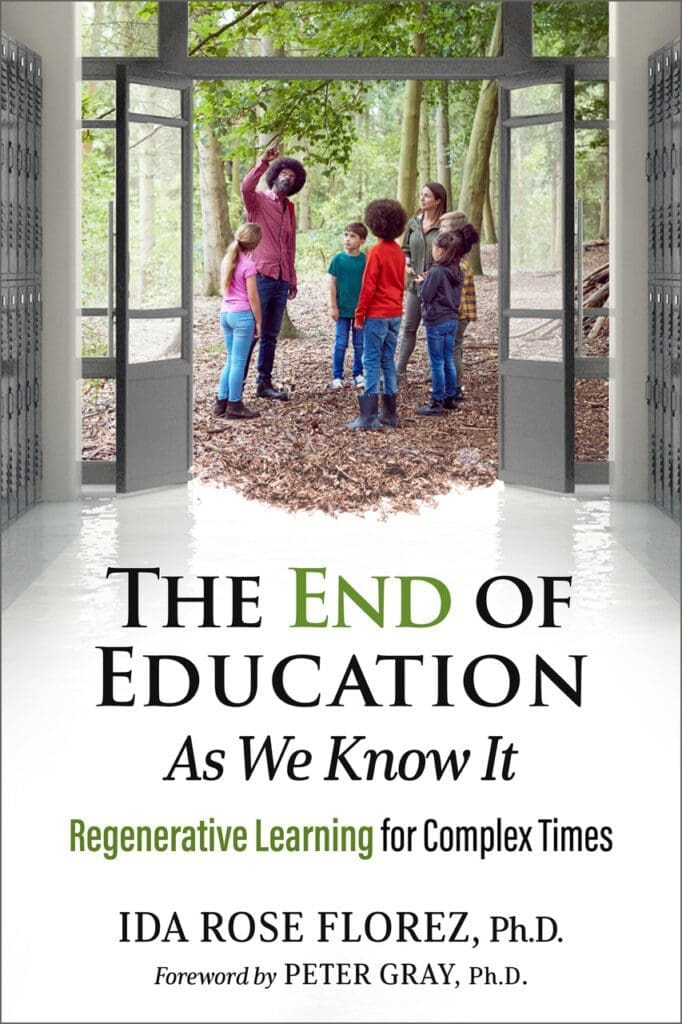
Schools play a critical role in defining our relationship to people and planet, but modern education reinforces a paradigm based on coercion, extraction, and exploitation. The End of Education as We Know It is a guidebook for transforming society through complex systems-thinking and regenerative ways of learning.
It’s time for a whole new way of doing school
People are born systems-thinkers. Education has the power to encourage our innate connection with the complex world, yet instead our schools focus on creating a workforce educated just enough to feed the capitalist workforce pipeline. Reminiscent of and building further on John Taylor Gatto’s education critiques, The End of Education as We Know It is for people who want to create schools that teach how to live in harmony with each other, with Earth, and all Earth holds.
Readers will understand when and how to engage in disruptive actions, manage system tensions, support child and adult learning, and use these skills to design whole new approaches to schooling. Far more than a call to education-reform-as-usual, Ida Rose Florez’s inspiring critique:
- Provides tools to explore patterns in education and influence patterns that lead to change
- Gives readers specific skills for working in complex systems, whether with a group of children, a contentious school board, or state or provincial governments
- Helps readers reimagine schools as places where communities learn together in a whole new way.
This clarion call to action rings a bell for teachers, parents, grandparents, educators, and policymakers to challenge the outdated paradigm of coercion and exploitation that shapes our current schools. It’s time to build a new educational model based on a resilient and regenerative future.







Ashlyn York –
This book is so necessary right now. That the way school is structured comes from a bygone era more suited to a time of assembly line style industrial production is very apparent. A regenerative mindset that embraces complexity, and her explanations of the complicated mechanistic thinking we are trained in at school versus a way to think about complex issues were a couple of my stand out takeaways from the book. The world is in need of a paradigm shift and it starts with the way we educate our children. As she says, ‘Our global problems emerged from our current ways of thinking. Our current ways of thinking cannot fix them.’
Annette Flinterman –
The title of the book captured me, as I’d just seen a documentary showing students in various cities across Germany, going on the street, protesting about their school system not suiting anymore. This book starts describing a great example of how a regenerative school works and highlights we need many people, in many places to offer great examples of how this new form works better than the system we currently have.
What I like about the book is how the road to get there is clarified in various steps and in a way I can use it myself to propose other changes in our societal system. Like moving from globalisation to localisation, changing our economic system … I’m writing this review just returning from a climate barcamp, which is a format where all attendants are talking on the same level, we all learn from each other, just like this should be in schools. We need a change not only in schools but in society and the tips of how to disrupt views and bring in curiosity, to reflect and to shift paradigms are great.
But we do have to start with schools, as we are all formed by “beliefs” put in place by the system we live in. I’m currently finalising a certified coaching training with the aim of helping people get over depressions, put in place by “old beliefs”. Children are the foundation of the future and there we should start to put things right.
Genevieve Dubois –
The End of Education as We Know It by Ida Rose Flores is a refreshing and eye-opening exploration of what education can and should be. Flores challenges the traditional system, inviting us to rethink learning by focusing on creativity, emotional growth, and nurturing each child’s unique strengths. Her approach resonates with the spirit of Waldorf education, emphasizing the whole child, but without the dogma. The book advocates for regenerative living, whole systems thinking, and an education that fosters harmony with the Earth and each other. For anyone seeking to build alternative education models, this is a must-read, offering a blueprint for an education that supports both human and environmental flourishing, truly the way of the future.