


Quick Cut Greens Harvester
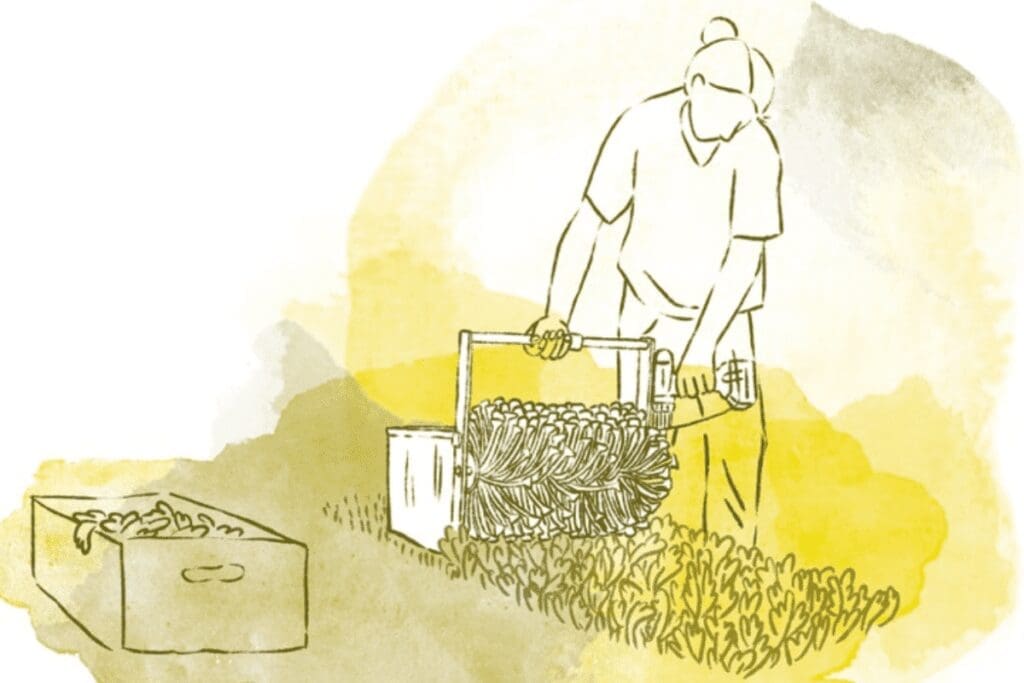
This tool was specifically designed to quickly harvest delicate baby greens and, above all, to do so as carefully and gently as possible.
Purpose and Advantages
The Quick Cut Greens Harvester consists of a metal shaft with a sharp horizontal blade and macramé brushes that resemble the spinning brushes used in car washes. The brush pushes the cut leaves back into a canvas basket.
The Quick Cut Greens Harvester is powered by a simple drill that drives the mechanism as it rotates. For best performance, opt for an 18-volt drill. It can also be used to harvest a wide range of greens, including mesclun, mustard greens, arugula, spinach, and baby kale.
How to Use It
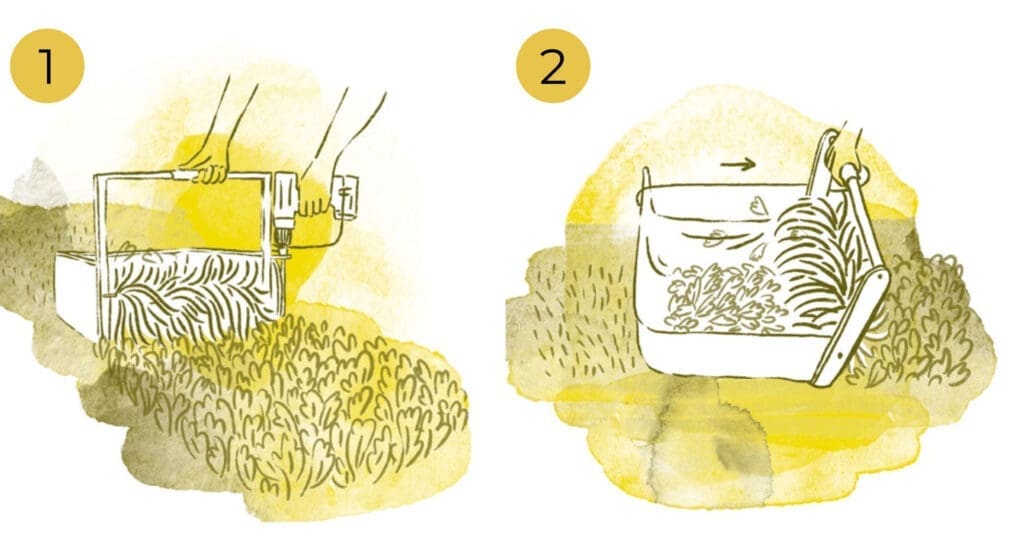
- Place your harvest bins at one end of the bed.
Hold the harvester with a firm grip, keeping it parallel to the ground.
Turn on the drill to get the brush spinning and drive the blade, which will cut the leaves while leaving the new growth at the heart of the plants intact. For cut-and-come-again crops, this means they will be able to grow back, to be harvested again. - With an 18-inch (45 cm) cutting width, the harvester can only cover half a bed, which is typically 30 inches (75 cm) wide. You will therefore need to harvest in two passes, first down one half of the bed, then turning the machine around to cut the second half. To do this, lift the harvester without stopping it, so that the brush continues to feed leaves into the canvas basket. Then, begin cutting the remaining half of the bed.
Tip from Jean-Martin Fortier
The Quick Cut Greens Harvester is a brilliant invention. Compared to the traditional method of using a knife, this tool harvests greens ten times faster, with an unbeatable output of 175 pounds (80 kg) per hour. The only prerequisite for good results is that your crop needs to be perfect. Because the tool is lightweight, it’s easy on the back. For maximum efficacy, make sure that the blades are sharp, and keep spare parts (drill batteries, belts, blades, etc.) on hand to avoid interrupting your harvest, and reverting to cutting greens with a knife!
Harvest Knife

The harvest knife is a versatile and indispensable tool that every market gardener should have in their pocket. Use it for harvesting and cutting or slicing vegetables.
Purpose and Advantages
For harvests, this knife can just as easily be used to cut roots, leaves, or stems. It is most often used for zucchini, leeks, and greens, especially mesclun, when growers do not have a Quick Cut Greens Harvester.
Opinel knives, made in France, are of high quality. When folded, they are very compact. And, thanks to a patented blade locking system, they can be used safely. They are also highly resistant to corrosion.
Tip from Jean-Martin Fortier

There is nothing worse than a dull knife, both in terms of the user’s safety and the blade’s effectiveness. To maintain your harvest knife, the best practice is to sharpen it before every use. This simple action barely takes a minute. Of all the existing models, I recommend the Opinel No. 10 because it is easy to grip, and the blade is the perfect size for an efficient and clean cut.
Pruning Shears

After the harvest knife, this is the second cutting tool you should always have on hand! Pruning shears are useful for getting a quick and clean cut whenever your knife cannot do the job.
Purpose and Advantages
Pruning shears can make more difficult cuts, complementing work done with a knife. Of the many available models and manufacturers, the Swiss-made Felco 310 is the ideal tool. It is durable and has straight blades that allow users to work on all types of plants, from vegetables and herbs to shrubs and fruit trees. It can also be used to harvest vegetables with tough stems, like peppers, eggplants, and artichokes, and for crop maintenance.