



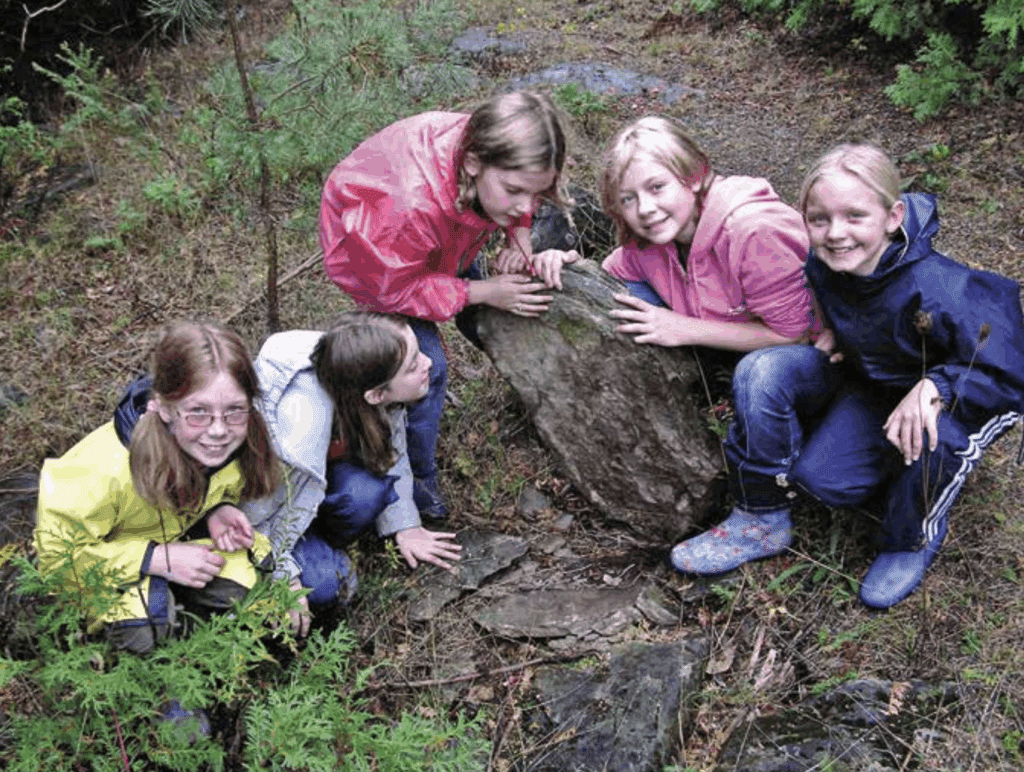
- Stop every once in a while and do a Hand Lens Hike (at least a 10 × power) along a fallen tree trunk or under a log or stone. Areas where there are different kinds of moss are especially good. Closely investigate leaf veins, flower parts, seeds, tree bark, the wings of a dead butterfly, etc.
- Have everyone lie down on their backs and watch the clouds pass over and the leaves wave with the wind.
- Periodically, simply sit and listen for several minutes — in complete silence — and then compare notes on what you heard. What were the natural sounds? Listen for the different sounds the wind makes as it passes through different trees. Some people can identify the tree by the sound the wind makes in its canopy. Can you?
- Pay attention to the wind as you walk along. Try to tell what direction it is blowing from. What do you see moving?
- Take note of where the Sun is in the sky. Use it to tell direction and to approximate the time of day.
- Collect natural objects such as rocks, leaves, seeds and bark of different shapes and colors. Stop and take the time to do a bark rubbing or a sketch. If there are flowers in bloom in large numbers, collect some of the blossoms.
- Play Basement Windows. Gently roll over a log or a rock. Peer underneath. Use a hand lens to take a closer look. Can you find a salamander, a centipede, a beetle, a millipede, an ant colony?
- Scan the area for signs of birds, including holes in trees, feathers, nests and droppings.
- Do the same for signs of mammals, such as tracks, scat, half-eaten cones, fur, browse marks, bark gnawed off shrubs or trees felled by beavers.
- Encourage the kids to feel and smell a leaf or bud or even a piece of mushroom. Rub it gently between their fingers. How does it smell? You might want to share the smell with others.
- Follow a bearing. Using a compass, strike out in one direction, then crouch down every ten paces and find out what is living there. This is the way biologists conduct a biophysical inventory of an area. You’ll be amazed at how life changes along this transect.
Featured Activity: Exploration Dice
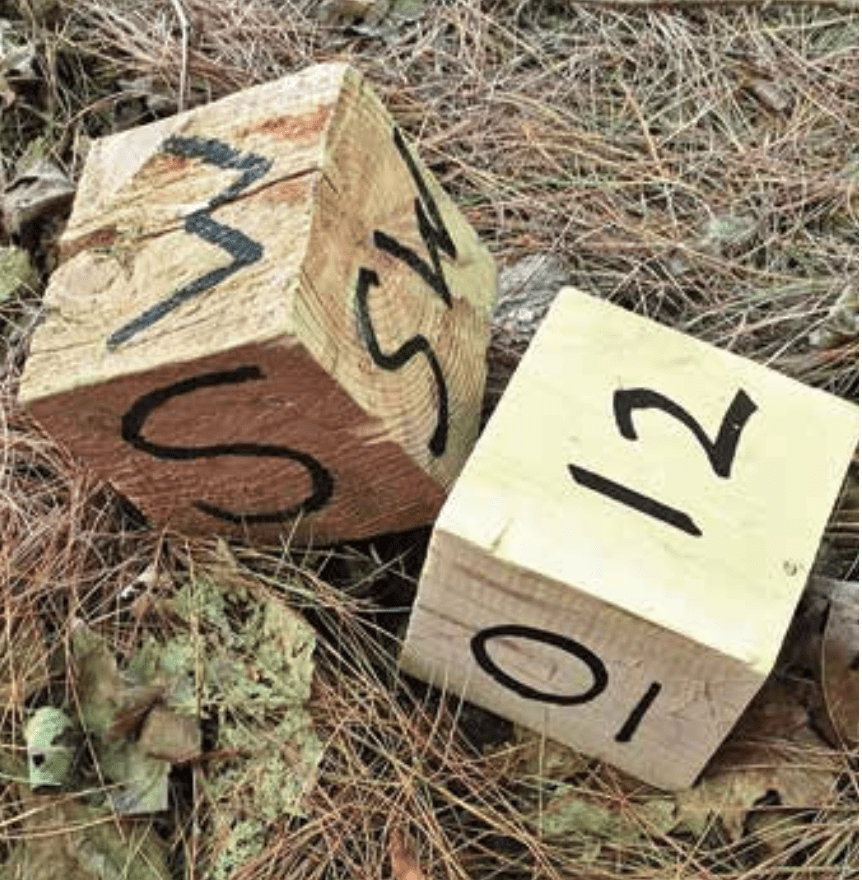
- Get two large wooden blocks (6 in./15 cm by 6 in./15 cm cubes).
- On one, place a direction on each face — N, S, E, W, NW, SE. On the other place six numbers: 4, 8, 12, 16, 20, 24.
- While walking, roll the dice.
- Using the compass, walk in the direction for the number of paces indicated, for example, NW for 12 paces. Then say “hunker down.”
- Ask kids to find something interesting near where they are crouching.
- The dice will bounce you around the landscape to places you might never have gotten to. And there is always something interesting to discover: a spider, a browse mark, a hole, a flower, an animal track.