
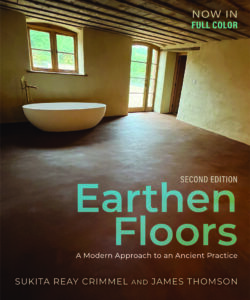




Sukita Reay Crimmel has installed over 20,000 sq ft of earthen flooring in the past decade. As well as presenting extensively on this exciting technique, she founded From These Hands, a green and natural building company located in Portland Oregon which specializes in earthen construction. Sukita is also the developer of Claylin – the first commercially available ready-made earthen floor product in North America. She holds a Bachelor of Science in environmental studies and architecture from the University of Oregon. She is considered one of the preeminent experts in the emerging field of earthen floors.
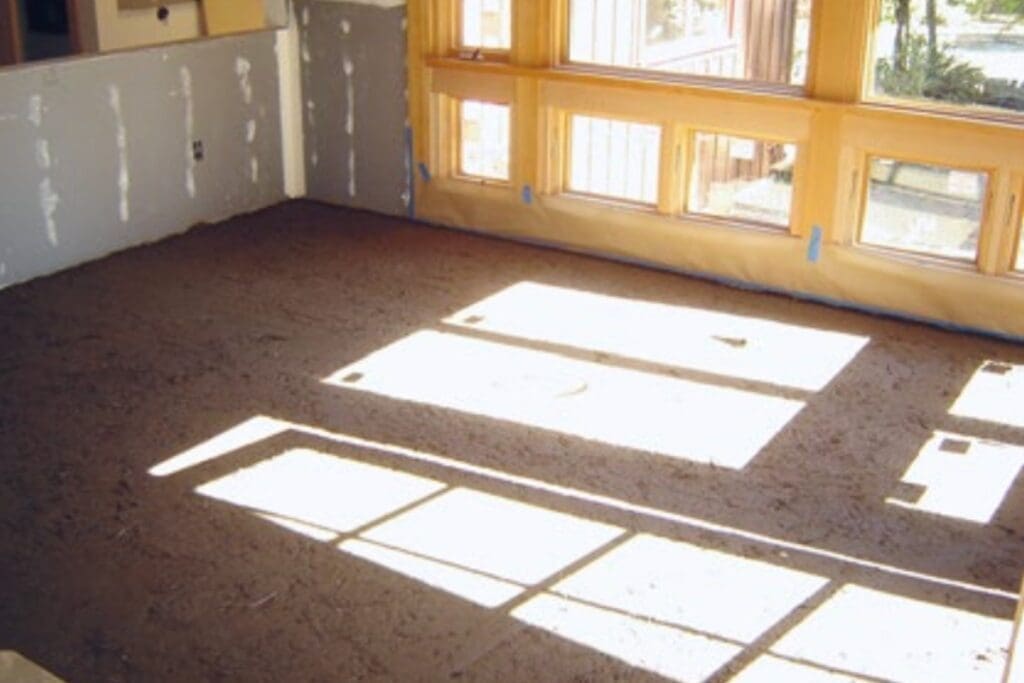
Summer is a great time to start that earthen floor project that you’ve always been wanting to try. Projects completed during the summer take less time and typically don’t require extra sources of heat or dehumidification; one of the biggest factors affecting the installation time of an earthen floor is the time it takes to dry. When the outside air is already warm and dry, an earthen floor can dry very quickly, sometimes in as little as 24 hours! In fact, in very hot and dry weather, installers may have to take measures to actually slow the pace of drying, by shading the floor and not using fans. It’s important that the floor dry evenly, so if there’s sunlight coming in through the window making a patch in the middle of the floor, that could cause that section to dry faster, leading to cracks.
Also, for burnishing, the floor needs to still be a little bit soft (we call it “leather-hard”) so the surface can still be worked. It’s not impossible to burnish a totally dry floor, but it is more challenging.
But with a good breeze and warm temps, a new floor will dry very quickly and be ready for oil, possibly in only 1 or 2 days. Air circulation (and warmth) also help the oil cure faster after it has been applied, so being able to leave windows open on warm breezy days helps to reduce the curing time. All in all, installing a floor in summer means things can move along much more quickly than during cooler, wetter times of year.
Earthen floors can help keep your house cooler in summer too (and warmer in winter)
“Passive solar design” is an approach to building design that allows for passive heating, cooling and lighting of a building without relying on mechanical equipment like heaters, pumps, A/C, or fans. This is accomplished by controlling how much sunlight enters a room or building, and how the corresponding radiant energy (heat) is absorbed and released.
For passive solar design to be effective, you need 5 basic things:
- A sunny spot with south facing windows (for those of us in the northern hemisphere)
- Insulation, to keep the heat in or out
- Thermal mass, to absorb excess heat when it is hot out and release it when it is cool
- A way to control how much sunlight (i.e., heat) gets into the building, such as shades, curtains, or roof overhangs designed to shade the summer light, and allow the winter light in.
- Ventilation, to allow excess heat to dissipate.
If you are building a new house, you can choose how you orient your house, how big (and at what angle) to build the roof overhangs, how much insulation to put in, and where to put windows and thermal mass to maximize solar gain in winter and minimize it in summer. If you are fortunate enough to be setting out on the journey of building your own house, make sure to learn how to integrate these elements, as good solar design can have a big effect on comfort and the costs of heating and cooling!
For the rest of us who are stuck with the house we already have, there are still things you can do to integrate passive solar design techniques. To help with summer cooling, the easiest changes we can make are 1) to keep sunlight out of the house by using external shades for any windows that let in a lot of direct sunlight (especially south and west facing windows), and 2) to add thermal mass inside. There are other more involved improvements that could be made, such as adding insulation and ventilation (think operable skylights, new windows, etc.), but those are more complicated and expensive fixes. Shading windows, and bringing in thermal mass, are relatively easy and low-cost improvements that will provide almost immediate results.
Shades: Put your shades outside, not inside!
We are used to having shades and curtains inside the house, so we can easily open or close them to adjust the light level, or for privacy. This is understandable, but this is not the right placement of shades to maximize passive solar cooling. If sunlight and its corresponding heat comes in through a window and is then blocked by a shade, it is still inside the room, it just gathers behind the shade or curtain; it will still eventually find its way into the room! The goal in summer is to keep the heat out entirely. Thus for any window that gets a lot of direct sunlight, especially in the hottest parts of the day, put a shade outside. People often use shade cloth for this purpose, or bamboo or reed mats that can be rolled up.
Mass: Bring thermal mass inside!

In summer, put an external shade up to block the sunlight, and heat in the room can be absorbed by the floor during the day, as long as it has the opportunity to cool off at night. (Illustration by John Hutton)
Thermal mass is the term used in building science to describe materials that help to moderate indoor temperature fluctuations in buildings by absorbing (and slowly releasing) heat. Materials that provide a lot of thermal mass are heavy and dense, like concrete, stone or earth.
Bringing thermal mass into a home will affect its thermal performance. It will take longer to heat up from a totally cold, unheated starting point, but will hold heat longer. To maximize the benefit of thermal mass, it should be used in conjunction with insulation (insulation outside, mass inside), and located in front of south-facing windows, where it can receive direct solar energy.
Earthen floors are a good source of thermal mass. While not as dense as concrete or stone, they still have good ability to store and release heat. Thicker floors provide more thermal mass. The question “How much mass is enough, or too much?” is beyond the scope of this article, but generally speaking, any amount of thermal mass can benefit the thermal performance of a house, and an earthen floor by itself will never be “too much” thermal mass.
In summer, an earthen floor can absorb excess heat during the day, and then release it at night, when it is cooler out. This really only works in places where the nighttime temperature falls enough that the thermal mass can cool off. It also requires ventilation, so it means opening windows, skylights, etc. to allow the heat to dissipate.

In colder months, an earthen floor placed in front of a window that receives direct sunlight will help radiate heat into a room, keeping it warmer. (Illustration by John Hutton)
You can think of thermal mass like a battery: When the temperature goes up, the battery will “charge,” which means some heat is being absorbed by the mass. When the temperature goes down, the battery “discharges,” releasing heat. This action helps to moderate indoor temperatures, keeping them cooler during the hottest parts of the day.
It’s hard to remember during the hottest parts of the summer that it was ever cold outside, but winter will surely come again, and thermal mass can be helpful in winter too, provided there is a way to get solar energy (sunlight) into the mass. Having an earthen floor in front of a south facing window that gets plenty of light during the winter is a great way to achieve this. Just be sure to take off the external shade you put up during the summer, so that sunlight can get inside!
So now that the days are longer, and the temperature is rising, it’s a great time to get started on that earthen floor project. It’ll dry faster in the summer heat, and if you’re attentive to using shades and ventilation properly, once it’s finished it can help keep your house cooler too.